Saturday, November 13, 2010

The Battle for World Public Opinion | Frontera NorteSur News

November 13, 2010

[On the GFMD & International Migration]


From Frontera NorteSur (FNS): on-line, U.S.-Mexico border news


Internationally, migration stands out as one of the most heated issues of the times. Across the world, restrictionist measures increasingly shape public discourse. On November 10 and 11, representatives of 146 governments met in Puerto Vallarta, Mexico, where they discussed how public perceptions of migrants figure in the contemporary global political landscape.


A consensus on combating the demonization of migrants was evident at the the Fourth Global Forum on Migration and Development (GFMD), but differences emerged on how best to counter anti-immigrant sentiments and whether governments-especially those from the developed world-are doing enough to curb outbreaks of xenophobia and support immigrants.


At one session, United Nations High Commissioner for Human Rights Navanathem Pillay stressed that governments are obligated to apply international legal instruments dedicated to the rights of migrants. Pillay urged more countries must ratify the Migrant Workers Convention. “It’s shameful that only about 40 states have ratified this convention, which has been around for about 40 years,” she said.


The host country of the 2010 GFMD, Mexico is among nations which has signed and ratified the Migrant Workers Convention.


Based in Switzerland, an international network of civil society organizations is promoting the ratification and monitoring of the agreement, which mandates that signatories accord rights to immigrant workers that are increasingly the source of heated political disagreement in developed nations. The members of the network include Anti-Slavery International, Human Rights Watch, the World Council of Churches and many other labor and human rights advocates across the world.


Fresh from a speech delivered to the Council on Foreign Relations in which he highlighted the “critical role” of immigration in US history, State Department official Eric P. Schwartz led the US delegation in Puerto Vallarta.


In a presentation to the GFMD, Schwartz, an assistant secretary for refugee and migration affairs, spoke about the Obama administration’s efforts to assist local and state governments in refugee resettlement and the integration of newcomers in host communities.


Although perceptions of migrants are shaped by interactions at the local level, it is incumbent on Washington to help ease the transition of migrants and their integration into society, Schwartz said. To do otherwise, he said, represents a federal let-down of local communities.


Government has a role to play in shaping public attitudes about immigration, Schwartz told a packed room, specifically through a leadership that channels concerns and fears, opposes the demonization of immigrants and emphasizes the costs to society of keeping migrants as an “underground population.”


Despite the prevalance of a “difficult conversation” on immigration in the US at the moment, Schwartz said demographic changes were among reasons he was optimistic about the long-term future of immigrants in a nation built up by immigrants. In the not-too-distant future, no single racial or ethnic group will constitute a majority in the US, he added.


A representative of the socialist government of Bolivian President Evo Morales questioned the immigration policies of the US and other developed nations. Eliciting a round of applause from an audience stacked with officials from different governments, Alfonso Ramiro Hinojosa, general director of consular affairs for Bolivia’s Ministry of Foreign Affairs, slammed measures like Arizona’s SB 1070 law for inflamming public opinion against migrants.


Schwartz countered that the Obama administration opposes SB 1070 and backs comprehensive immigration reform as an answer to the growing attempt by states to assume federal authority. In comments to Frontera NorteSur, Schwartz reiterated that President Obama is against several parts of SB 1070, and both the US president and Secretary of State Hillary Clinton have taken time to “articulate their set of concerns” about the law, as well as speak out on the general importance of immigration to “our well-being.”


Internationally, SB 1070 continues being a contentious matter. In Puerto Vallarta, flyers were passed out at the GFMD urging readers to contact Major League Baseball Commissioner Bud Selig and demand that the 2011 All-Star Game be moved out of Phoenix.


Washington’s response to SB 1070 is still “insufficient,” Bolivian official Hinojosa told Frontera NorteSur. “This law continues generating dramas among migrants in our countries,” Hinojosa said. Bolivia’s posture, he said, is shared by the rest of South America.


In late October, Bolivia hosted the most recent meeting of the South Amercan Conference on Migration, a grouping which brings together 12 nations. The regional sentiment, Hinojosa added, is to uphold a “dignified immigration” that respects human beings who are usually subordinated to the interests of capital.


Founded in 1999, the South American Conference on Migration promotes a gradual but decisive drive towards a “regional integration based on the construction of the free mobility of persons and South American citizenship,” according to an organizational document.


Hinojosa estimated that about 250,000 Bolivians currently reside in the US. In the bigger scheme of things, Bolivia is among countries in the world that could be most impacted by climate change and forced migration – issues which were considered in this year’s GFMD.


According to Hinojosa, President Morales’ government considers a climate agreement at the upcoming Cancun summit a “top priority,” but will not be too disappointed if no accord materializes from next month’s world meeting. The massive turn-out of 30,000 at the Cochabamba climate conference hosted by Bolivia last spring is an example of the inexorable tide in favor of climate action, Hinojosa insisted.


“We’re accumulating forces,” the Bolivian diplomatic official said. “If not Cancun, something soon.”


On immigration, Hinojosa said “double-talk” characterized the stances and policies of developed countries. Besides SB 1070 in the US, he exorciated Italy’s denial of health care to migrants, France’s deportation of Romas and the failure of developed nations to ratify the Migrant Workers Convention.


Hinojosa said he was dismayed that he had not heard a single Mexican official address the massacre of 72 Central American and South American migrants in the northern Mexican border state of Tamaulipas last August. “Not talking about it, doesn’t make it go away,” he maintained.


Not surprisingly, debate at the GFMD examined the role of media in shaping public perceptions of migrants. A representative of Lebanon reported how radio spots promote a positive image of immigrants, whose exodus after war broke out with Israel in 2006 caused a crisis for a small country suddenly short of foreign workers.


An official from the Phillipines described how his government employs the popular soap opera format on television to give migrants a high-profile in the public sphere. Armed with access to all the latest statistics on immigration and its economic impacts, the GFMD should do more in the public relations field for migrants, some speakers concurred.


Several members of non-governmental organizations were allowed to address government meetings of the GFMD. While pledging to continue her work against racism and xenophobia, Carol Barton of the United Methodist Church in the US said economic changes were needed to counter public insecurities that stem from the economic crisis and fan anti-immigrant attitudes.


“Just giving facts and figures doesn’t change the reality of those fears,” Barton said. Concrete action was necessary on home foreclosures, mass unemployment and other problems arising from the Great Recession, she said. Getting to the structural roots of economic problems, the church activist contended, was paramount “if we are going to end this kind of backlash that’s directed against migrants.”


The next GFMD is scheduled for Switzerland in 2011.


-Kent Paterson

Frontera NorteSur (FNS): on-line, U.S.-Mexico border news

Center for Latin American and Border Studies

New Mexico State University Las Cruces, New Mexico


For a free electronic subscription email: fnsnews@nmsu.edu

Labels: , , , , , , , ,

Thursday, November 11, 2010

La AGP es un reto para mirar más allá de Carolina del Norte

The PGA is a challenge to see beyond North Carolina [See English version below]

Por Ada Volkmer

Recuerdo que me dio escalofrío cuando escuché que iba a participar en la reunión sobre la Acción Global de los Pueblos sobre Migracíon, Desarrollo y Derechos Humanos (AGP). Me emocionó pensar en salir de mi rutina cotidiana y ver el tema de migración con una perspectiva internacional.

En la AGP fueron cuatro días de plenarias, comidas, mesas redondas de discusión, reuniones, mezcal, baile y talleres donde cientos de activistas pro-migrante de todo el mundo se reunieron para compartir experiencias, sumar energías y combatir los sistemas que ignoran los derechos humanos.

Reflexionando sobre la semana pasada puedo decir que algunos momentos clave fueron:

Cuando una revolución de música derrumbó a Nora Jones con canciones y lemas de protesta de Marruecos, Estados Unidos, Togo y México (Como dice Arnoldo, pueblo que no canta, es pueblo que no vive);

Y también cuando yo era la única persona de los Estados Unidos en una reunión paralela sobre la detención y la deportación.

Esto era lo que quería salir de Carolina del Norte, la maldita 287g y los EEUU para hacer conexiones entre lo que esta pasando en mi comunidad y las muertes de inmigrantes en centros de detención en Corea del Sur;

La privatización de centros de detención en Malasia, la negación de la ciudadanía a hijos de migrantes Haitianos en la República Dominicana y los centros de detención aislados donde los inmigrantes no tienen acceso a recursos o consejo legal en México.

Los EEUU es un modelo para el resto del mundo y esta exportando la militarización de las fronteras, el duro cumplimiento de la ley de inmigración, la privatización de centros de detención y un marco de seguridad nacional que criminaliza a los seres humanos.

La AGP es un reto para nosotros como coalición de mirar mas allá de los veinte condados del oeste de Carolina del Norte, mas allá de la frontera México-EEUU y mas allá de las reformas de leyes anti-inmigrante estatales y nacionales. Es un reto para pensar a escala mundial y recordar que la migración es un producto de el colonialismo, el racismo, la explotación, la pobreza y la desigualdad.

Gracias a NNIRR por esta oportunidad. ¡Viva la justicia! ¡Viva México! ¡Viva el AGP!

Ada Volkmer es la Coordinadora de la Coalición de Organizaciones Latino-Americanas - una red de centros Latinos en las monta~as del oeste de Carolina del Norte.

*

The PGA is a challenge to see beyond North Carolina

By Ada Volkmer

A year ago, I heard about the People's Global Action on Migration, Development and Human Rights (PGA) and I remember getting chills. The possibility of getting out of the daily routine, going international and looking at migration from an global perspective game me something to get excited about.

These four days of plenaries, box lunches, round tables, caucuses, mezcal, baile, and workshops brought together hundreds of migrants rights activists from around the world to share experiences, gather energy, and challenge the systems that ignore human rights and place the development of sending countries in the hands of migrants.

I'm still trying to get my thoughts around this last week, but I can say that highlights included:

A music revolution one morning in which Nora Jones was replaced with songs and chants from Morroco, United States, Togo and Mexico (Como dice Arnoldo, pueblo que no canta, es pueblo que no vive), and being the only person from the United States in a detention and deportation caucus.

It was just what I was hoping for – to leave North Carolina, 287g and the US and make the connections about migrant deaths in detention centers in South Korea, the privatization of detention centers in Malaysia, the denial of citizenship to children born of Haitian migrants in the Dominican Republic, and detention centers in rural parts of Mexico where migrants have little access to resources or legal advice.

The United States is providing a model for the rest of the world and exporting the militarization of borders, enforcement regimes, the privatization of detention centers and a national security framework that unjustly criminalizes human beings.

The PGA challenges us as a coalition to look beyond our small scale (twenty counties in rural Western North Carolina), the US-Mexico border, and state and national reform of anti-immigrant laws and policies. It challenges us to think globally, to remember that migration is a product of colonialism, racism, exploitation, poverty and inequality.

Gracias a NNIRR por esta oportunidad. Viva la justicia! Viva México! Viva el AGP!

Ada Volkmer is the Coordinator of COLA – a network of Latino community centers in the mountains of Western North Carolina.

[Photo by / Fotografía por Arnoldo García.]

Labels: , , , , , , , , , ,

Thursday, November 04, 2010

At the PGA: Migrant Rights Unite Us Across Borders

Salaam from the third day here at the People´s Global Action on Migration here in Mexico City!

By Monami Maulik

I am here at the People's Global Action gathering in Mexico City with with my colleague, Ayesha Mahmooda. Ayesha is a former youth member of DRUM and current Worker Organizer and has lived undocumented in the U.S. for 19 years until winning her deportation case this year.

I am excited to be here together representing South Asian and Muslim communities in the U.S. who are members of DRUM-Desis Rising Up & Moving. DRUM organizes a membership of over 1,000 South Asian and Muslim low-wage workers and youth who are fighting for their rights as migrants in the U.S.

We Raise Our Voices From New York to Mexico

DRUM played a major role in hosting the first ever People´s Global Assembly in New York City in 2005 as the UN released its report after the Global Commission on Migration and Development process. I had the chance also to testify at the last GCMD in Mexico City in 2005 about the need to de-link migration policy from national security.

In New York City DRUM hosted over 50 migrant leaders from Latin America, Asia, and Europe in our community of Jackson Heights. Bangladeshi women, who spoke no Spanish, shared our traditional food with Latin American women migrant leaders who spoke no English -- but they understood each other´s struggle without words. Later that week, we organized a town-hall and action at the UN as we saw the increasing importance this global process would take over the next decade.

We did not want unaccountable governments, private corporations and exploitative international institutions like the World Bank to decide our futures for us.

We decided that DRUM must raise the voice of migrant people ourselves in this global process towards human rights for migrants, rather than allowing the GFMD to only view migrants as tools to make greater profits for sending and receiving nations and corporations.

Migrant Rights Unite Us Across Borders

We are very honored and excited to be present at this international gathering with hundreds of migrant rights leaders from across the globe. We are humbled to be in Mexico, from where many of the 14 million undocumented brothers and sisters of ours in the U.S. come from. We see the dignity and pride in the faces of workers here, of indigenous people and the poor who are displaced by NAFTA yet continue to struggle for a better world. Mexico has a rich history and legacy of the workers and poor waging revolutionary movements for equity and human rights for all people.

On opening day of the PGA, I spoke on the welcome plenary about the need to unite across nationalities, both within the U.S. and globally, to challenge the 'national security' framework that is destroying the rights of migrants around the world.

The U.S after September 11, 2010 has created and spread this model of permanently placing all issues of migration as a permanent threat to national security, stoking exaggerated fears of terrorism. In the U.S., this has meant the mass raids, deportations and unjust imprisonment of thousands of Muslim immigrants. But it has not ended there and will only increase for all communities of color.

The national security paradigm in the U.S. has fundamentally channeled billions of dollars and unparalleled law enforcement resources towards the immigration enforcement regime of the Department of Homeland Security -- both in the interior and by hyper militarizing the borders.

This is at the same time that the US is waging endless wars and occupations that have murdered over 1.5 million people in the Middle East and South Asia since 2002. As the mothers of victims of this attack on Muslims in our membership say, "The government is manufacturing terrorists out of poor migrant workers in order to justify its endless wars abroad and security regime."

Yesterday, as we participated in a roundtable on National Security & Migrant Rights, this same story was told by half a dozen people from all over the world -- from Thailand to Mali, from Holland to Mexico. I learned that in Mexico, the government is copying the U.S. model and converted its national Migration Institute into the National Security Institute. Moreover, the Mexican government has opened up "Migration Centers" as National Security detention facilities that are top secret, deny access to lawyers and others, and use abusive tactics on migrants.

Under the national security paradigm, the end goal here is the same as everywhere : to permanently by-pass human rights and accountability and to justify non-transparency and the abuse of migrant people. A Haitian migrant leader from the Dominican Republic spoke about how Haitian migrants in the DR are being detained as 'national security' threats by claiming they will create crimes and degrade the environment.

Human Rights and Sustainable Development Make Us Safer

Today, we held a formal workshop on "National Security & Human Rights of Migrants" and drafted proposals that will be presented to the governments at their Global Forum on Migration and Development, where civil society will pressure the governments:
1) De-link migration policy from National Security globally, and
2) Reject the framework of National Security and replace it with "Human Security" -- that when human rights and access to sustainable development are provided for all, communities and nations are safest.

We are raising the issue of national security at the GFMD even though the U.S. government has been silent on the issue. We know that the U.S. is actively promoting this new tool to suppress rights and accountability behind closed doors with other governments. As Muslim migrants in the U.S., we are building bridges with our colleagues globally because we see that our organizing for human rights are interdependent and that none of us can win alone.

Saludos!

Monami Maulik
Executive Director, DRUM-Desis Rising Up & Moving

Labels: , , , , , , , ,

Women migrants, women organizers at the PGA, leading the struggle for justice & human rights

By Laura Rivas

This is Day 3 of the fifth People´s Global Action on Migration, Development and Human Rights in Mexico City.

This morning, we heard from Ana Avendaño [who works for the AFL] and William Gois [from Migrant Forum Asia] among others who spoke about the challenges we face to link issues across social justice movements and to create opportunities to work together to continue pushing for changes in policies affecting migrants and immigrants around the world.

So far, the highlight of the PGA for me has been participating in the workshop on Gender and Migration, held last night at the Ex Convent of San Hipólito, among the ghosts of women who have walked these hallways and traversed these corridors.

Women and men from communities around the world including the Philippines, Mexico, Korea, India, Africa, and the U.S. shared stories of women migrants impacted severely by inhumane repressive migration policies, and violence across the spectrum of family, work, community, the state and its agencies, and in transit from their home countries to the country of destination.

Quite literally, "from the womb to the workplace," women migrants experience human rights abuses and rights violations on a personal, physical, political, cultural, religious, and legal/constitutional level.

But as one of the sisters shared, we have a big task ahead of us, not only to ensure that a strong gender lens is cast over the broader discussions on migration, development, and human rights but also that as organizers, human rights defenders, advocates, activists, and community members, we make a commitment to work together to raise the voices of migrant women across the globe for justice and human rights.

| Laura Rivas co-coordinates the NNIRR's HURRICANE initiative (Human Rights Community Action Network) and organizes with community groups to document human rights violations and abuses. Photographs by Arnoldo García. |

Labels: , , , , , , ,

Our culture, our words, our rights go with us wherever we go

EXILIO

Pablo Neruda

Your exile is round
a circle, a ring:
enveloped by your feet, you cross the earth,
but it is not your earth,
the light awakens you, but it is not your light,
nigh falls: you stars are missing
and you find brothers and sisters: it is not your blood

You become a ghost, ashamed
for not loving morethose who so love us.
and it is yet so strange to miss
the hostile thorns of your homeland,
the coarse neglect of your people,
the bitter affairs that still await
and howl at you at the door

*

EXILE

Pablo Neruda

El destierro es redondo
un círculo, un anillo:
le dan vuelta a tus pies, cruzas la tierra,
no es tu tierra,
te despierta la luz, y no es tu luz
la noche llega: faltan tus estrellas,
hallas hermanos,: pero no es tu sangre.

Eres como un fantasma avergonzado
de no amar más a los que tanto te aman,
y aún es tan extraño que te falten
las hostiles espinas de tu patria.
El ronco desamparo de tu pueblo,
los asuntos amargos que te esperan
y que te ladrarán desde la puerta.

Pablo Neruda (1904-1973) was the preeminent poet of Chile and was awarded the Nobel Prize for literature in 1971.

Pablo Neruda (1904-1973) fue uno de los poetas más destacados de Chile; le otorgaron el Premio Nobel por literatura en 1971.

*
The following poem was published on the back cover of the program of the People's Global Action for Migration, Development & Human Rights.

Labels: , , , , , , , ,

Wednesday, November 03, 2010

Opening Day at the Peoples Global Action

By Rubén Solis
Southwest Workers Union
Mexico DF
Nov. 2, 2010

Yesterday was ‘dia de l@s Muert@s’ and the opening of the Peoples Global Action (PGA) took a \ minute of silence to remember all of the souls of migrants that have died.

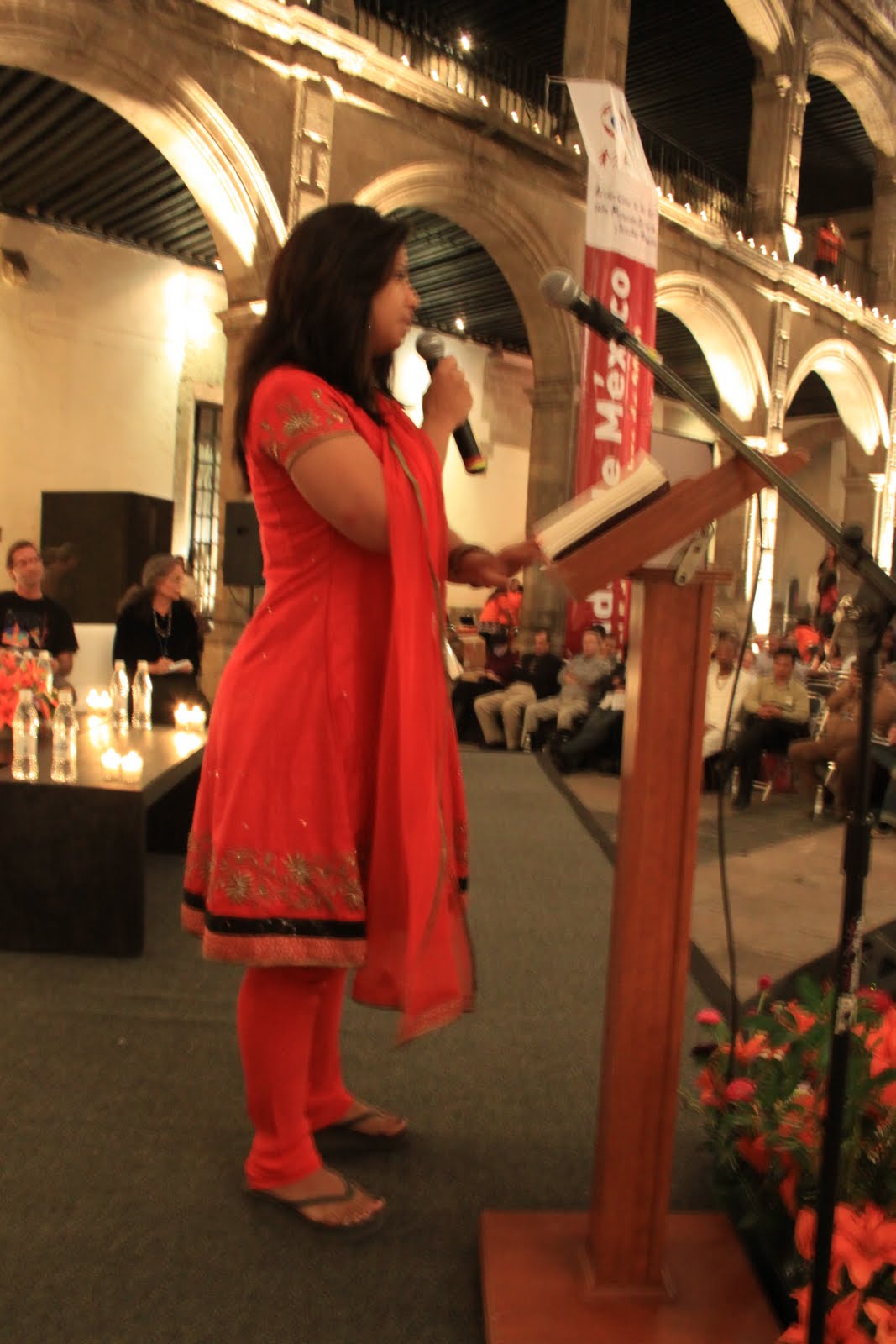
The opening of the 5th Gathering of PGA took place in the historic center of Mexico DF in the ‘Convento Hipólito’. Several of the organizing leadership spoke in the opening including the main opening words by Colin Rajah of the National Network for Immigrant & Refugee Rights (NNIRR) from the United States.

The opening program included a panel of six representatives of different regions in various continents including a sister from the Middle East, Africa, Asia, and the United States. The speakers framed the issues of migrant rights both in terms of the violation of Human Rights and the resistance and organizing work taking place against all risks. Migrants risk their lives in their transit from their country to the country of destination but organizers of migrant rights also risk their lives in the work of defending migrant human rights.

The opening of the PGA also heard from the organizing committee in Mexico DF and the Mexico City government under-secretary to the Mayor of this millennium city, welcoming the delegates and wishing the best in the work for the days ahead. The Mayor’s representative highlighted that Mexico DF is a city of transit for millions of migrants and thus the City government is aware of the issues related to migrant rights.

The opening night ended with fabulous music by the youth band from Michoacan. A ‘jarocho’ group also presented music from the Veracruz region. The hosts of the opening night served great traditional Mexican food, drinks like orchata and Jamaica, wine and Mezqual for the brave.

The opening night could not be absent of beautiful ‘altares’ commemorating the dead as it is celebrated widely in Mexico. Thousands of people were out in the street of Mexico celebrating the day of the dead.

The opening day of the PGA was very welcoming to the delegates coming from some 70 countries representing Asia, Africa, Central America, North America and South America and the Caribbean. The delegation from the United States, organized under the banner of National Network for Immigrant & Refugee Rights (NNIRR), has close to 75 delegates with representatives from across the United States. Southwest Workers Union, a member organization of NNIRR is represented by Ruben Solis who will be participating in two workshop presentations on Migrant & Labor and Migrants and Free Trade.

Editor's Note: Rubén Solis is a co-founder of the Southwest Workers Union, absed in San Antonio, Texas.

Labels: , , , , , , , ,

Sunday, October 31, 2010

U.S. Immigrant Groups Converge in Mexico, Join Global Call for End to Criminalization and Exploitation of Migrants

Contact:
Colin Rajah (415) 203-8763 crajah@nnirr.org
Catherine Tactaquin (510) 459-4557 ctactaquin@nnirr.org

(Mexico City, Mexico) Dozens of U.S. immigrant groups are heading to the 5th People’s Global Action on Migration, Development and Human Rights (PGA) being held in Mexico City Nov. 2-5. The PGA is a community-based gathering to develop and advocate alternatives to the 4th intergovernmental Global Forum on Migration and Development (GFMD), meeting a week later in Puerto Vallarta on Nov. 10-11.

Led by the National Network for Immigrant and Refugee Rights (NNIRR), close to 80 groups from around the U.S. will join an estimated one thousand other civil society delegates from around the world at the PGA. This will be one of the largest international civil society gatherings focused on one of the most contentious issues worldwide, migration. NNIRR is a co-founder of the PGA.

“There is an unprecedented increase in hostility towards migrants around the world, including in the U.S.,” declared Colin Rajah, Director of NNIRR’s program International Migrant Rights & Global Justice and a member of the PGA international coordinating committee. “As governments discuss ways and means to maximize the development benefits of migration, migrants themselves are being traded as cheap and disposable labor commodities.”

Raising Migrant Voices for Justice & Human Rights

During the PGA, community- based, human rights, women’s, faith-based, labor, migrant workers and other organizations from Africa, Asia, the Americas, the Caribbean, and Europe will share their experiences, strategize and develop action plans to counter the growing government attacks undermining the rights and safety of migrants. Key PGA representatives will also attend the Civil Society Days Nov. 8-9 at the GFMD, and will be delivering one of four international civil society presentations during the government forum.

The PGA serves as a broad-based civil society forum exposing governments’ repressive and inhumane criminalization of migrants around the world and the increasing exploitation of migrant workers in vulnerable and precarious conditions. The PGA also advocates for better global governance and adherence to human rights protections of migrants.

U.S. Will Attend GFMD for First Time

For the first time, the U.S. State Department will be leading an inter-agency delegation of a dozen government representatives to the GFMD. Assistant Secretary of State Eric Schwartz, heading the delegation, is expected to deliver a speech in New York on Nov. 8, in conjunction with the opening of the GFMD.

Rajah commented, “While we applaud the Obama Administration’s reversal of the previous U.S. government policy of non-participation in international fora such as the GFMD, we are concerned that there is little if any indication that the U.S. will modify it trade and migration policies, which drive the forced displacement of communities and violate the rights of migrants. We will be pushing the U.S. to turn around these policies and end the repressive and inhumane treatment of migrant communities. The U.S. must comply with the international human rights protections of all migrants around the world, including in our own country.”

The GFMD was created in 2006 by the United Nations General Assembly, upon the recommendation of then UN Secretary-General Ban Ki-Moon. While its mandate seeks to overcome the limitations of strictly national approaches to key migration issues, the GFMD has become a key site for developing migration and development policy at the expense of the rights of migrants and countries in the Global South.

The inaugural GFMD was held in Brussels in 2007, followed by Manila in 2008 and Athens in 2009. The Swiss government is expected to host the GFMD next year.

The PGA: Creating a Global Vision & Action Plan for Migrant Rights

The PGA was jointly created by regional migrant and migrant rights networks from around the world. Recognizing the limitation of the GFMD’s framework approach, it sought to raise the level of broad civil society engagement as key stakeholders in the debate, and more importantly, to promote the central role of human rights as a framework for migration and development.

Labels: , , , , , , , , , , ,